
From Research to Action: Bringing Wellbeing to Life with stormbreak
Discovering stormbreak and the Power of Mentally Healthy Movement
Sophia Woollard. stormbreak Programme Manager
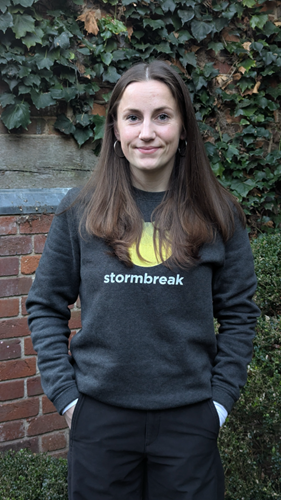
My name is Sophia and I am delighted to be one of the newest members of the stormbreak team, joining as Programme Manager. I have wanted to be a part of the stormbreak mission for 6 years and am so pleased to be part of such an expert team who are wanting to make a difference for children’s mental and physical health.

My stormbreak Journey
My journey to stormbreak began in 2019 during my undergraduate studies for a Bachelor of Education in Primary Education with Qualified Teacher Status at Winchester University. Throughout my degree, I found myself consistently drawn to the wellbeing side of education and chose to specialise in Physical Education. Sport and physical activity have always been central to my own self-care, both growing up and in adulthood. Experiencing firsthand how powerfully physical activity can support wellbeing has been a driving force behind my desire to be part of stormbreak. I’m passionate about helping children experience those same positive benefits and supporting their emotional wellbeing through movement.
My passion for children’s well-being and physical education encouraged me to develop my undergraduate research. Through my dissertation supervisor, Dr. Vicky Randall, I was introduced to stormbreak which resulted in me conducting action research on the impact physical education can have in supporting children’s emotional health and well-being using ‘stormbreaks’. Following this research, I was deeply inspired by stormbreak’s mission and impact. After completing my degree, I incorporated stormbreak principles into my practice while working within a primary school federation.
Teaching Through the Pandemic: A Catalyst for Change
During my time working in education, I witnessed firsthand the significant pressures placed on teachers to meet academic targets and departmental expectations. Too often, these demands came at the expense of prioritising children’s mental health, wellbeing, and opportunities to be physically active. Physical education and movement are frequently the first thing removed when core subjects need further prioritisation. This tension was especially pronounced as I entered the profession during the COVID-19 pandemic, a period that intensified academic scrutiny while children’s emotional needs grew more complex and urgent.
These experiences deepened my interest in the psychology of education, particularly in understanding how academic pressures shape teachers’ decisions about wellbeing provision. This led me to pursue a Master of Science in the Psychology of Education, accredited by the British Psychological Society (BPS). My research focused on teachers’ perceptions of supporting children’s emotional health and wellbeing in primary schools, exploring the challenges they face and the importance of embedding wellbeing within everyday practice. The findings closely reflected what I had experienced in my own teaching: educators overwhelmingly recognised the value of nurturing children’s wellbeing, yet felt constrained by curriculum pressures, limited time, and competing academic expectations. Many reported wanting to integrate more emotional support into the school day but struggled to do so within the current educational climate. This alignment between research and practice further reinforced my commitment to championing wellbeing as a fundamental part of children’s educational experience.
Researching and Publishing Teachers’ Perspectives on Wellbeing Support
Captivated by the findings—and aware of the limited research on teachers’ views of supporting children’s emotional wellbeing in primary schools—I was keen to share this work. With the guidance of Dr. Vicky Randall, we co-authored the study, later published in Educational Psychology in Practice (Taylor & Francis, 2024).
Our journal article,“Exploring Teachers’ Perceptions of Supporting Children’s Emotional Health and Wellbeing: A Post-COVID-19 Perspective” gave primary school teachers in the South west of England the opportunity to share their experiences and perspectives on supporting children’s emotional health and wellbeing — something I believe is more important now than ever.
From Research to Practice: Supporting Teachers and Children’s Emotional Wellbeing
My research highlighted that teachers are often the first to notice when children struggle emotionally, yet many feel under-trained, under-resourced, and constrained by workload—a finding that strongly resonates with my work at stormbreak.
I now support trusted adults in embedding mentally healthy movement into everyday school life, helping children thrive while equipping teachers with practical tools, confidence, and a whole-school approach to wellbeing. This aligns closely with stormbreak’s Surge programme, which empowers all staff to make emotional wellbeing a shared responsibility through everyday movement and connection.
The study also revealed challenges around referrals for children with emerging mental health needs and broader systemic barriers in supporting wellbeing. At stormbreak, these insights directly inform initiatives like stormbreak Shine, a digital pathway that enables early, evidence-informed support, and the Dorset PINS Community of Practice, which creates collaborative spaces for educators to share ideas and co-create practical approaches.
In my current work, I hear the same challenges from educational professionals today, and it’s rewarding to see research findings translated into scalable, practical solutions that empower teachers and improve children’s emotional health.
It is incredibly rewarding to see my research translated into real-world action through stormbreak, enabling education professionals to better support children. Witnessing the tangible impact on teachers’ confidence and children’s wellbeing is both a privilege and a driving passion that guides my work every day.
To find out more about the stormbreak approach please take a look here:
stormbreak.org.uk/shineinsight2025
stormbreak.org.uk/surgeinsight2025
Get in touch with me sophia@stormbreak.org.uk